
I Walked Into China's Biggest Jadeite Market at 5 AM — Here's What Overseas Buyers Need to Know
Tian'guangxu in Sihui is where jadeite dealers from across Asia come to trade before the sun rises. I'm there every week — and today I'm taking you inside the market to show you what it's really like, what to look for, and how to buy jadeite from China without getting burned.
Tian'guangxu: China's "Dawn Fair" for Jadeite
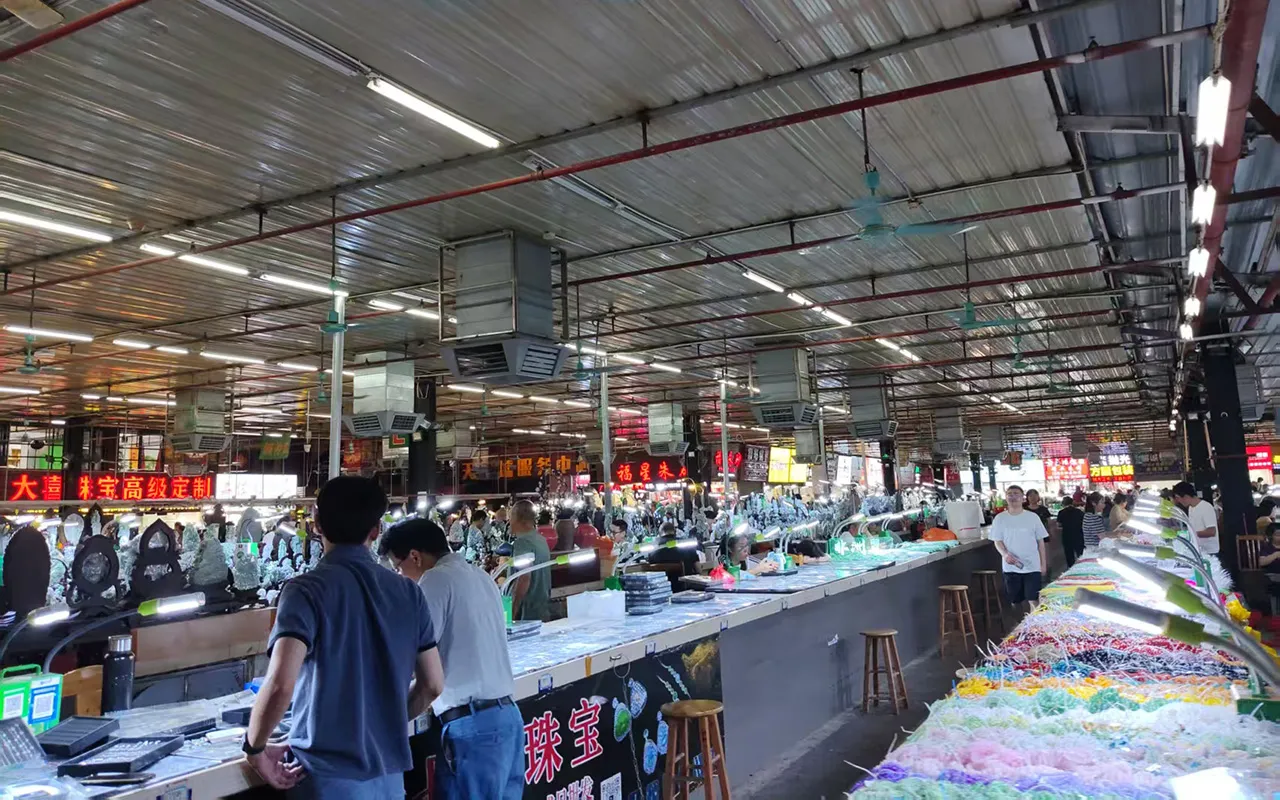
Tian'guangxu at first light — the market is already packed before most people have had their coffee.
The name Tian'guangxu (天光墟) literally means "Dawn Fair." That's not a poetic nickname — it's literally what happens here. Traders start setting up around 4 AM. By 5 AM, the aisles are packed. By 7 AM, the serious business is mostly done. If you show up at 9 AM thinking you'll get the best picks, you're too late.
This market is in Sihui, Guangdong Province — about 90 minutes west of Guangzhou and less than 30 minutes from our office. Sihui has been a jadeite trading hub for decades. Most of the jadeite jewelry you see in Guangzhou's retail stores, Shenzhen shopping malls, and even Hong Kong's Nathan Road was originally sourced from right here.
One important clarification: this market deals in jadeite (翡翠, feicui), not nephrite jade (和田玉). If you're sourcing nephrite, that's a different supply chain — mostly out of Xinjiang. But if you want jadeite — bangles, pendants, bracelets, beads, carvings — Sihui is ground zero.
Why This Market Matters for Your Business
Sihui handles an estimated 60–70% of China's jadeite trading volume. That means better selection and more competitive pricing than sourcing through a factory or online wholesaler. Our office is 30 minutes away — we're physically here every week.
But here's the thing nobody tells you: this market is not designed for foreigners. There are no English signs. No price tags. No refunds. Every stall owner expects you to know what you're looking at. That's exactly why having a local sourcing agent matters — not just for language, but for knowing which stalls are honest, which prices are fair, and which "Grade A" pieces are actually Grade B.
What You'll Actually See Inside the Market
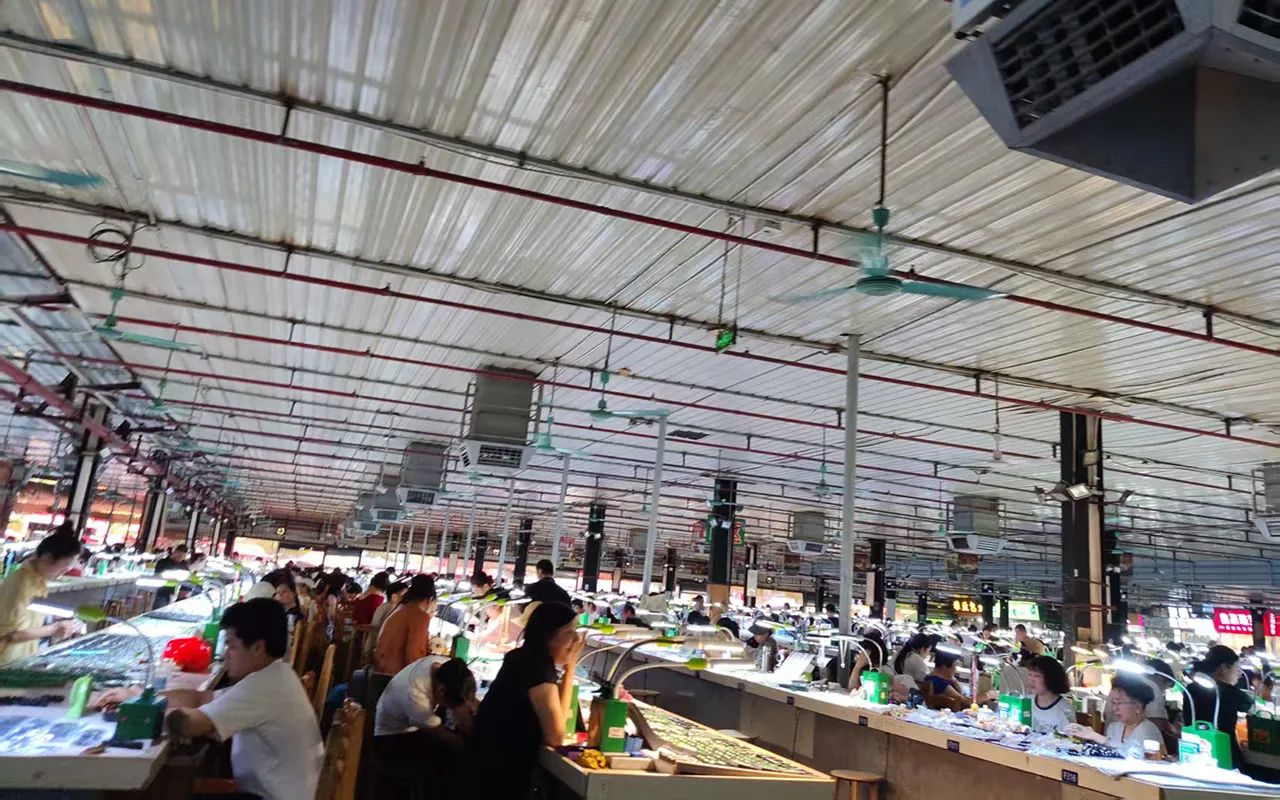
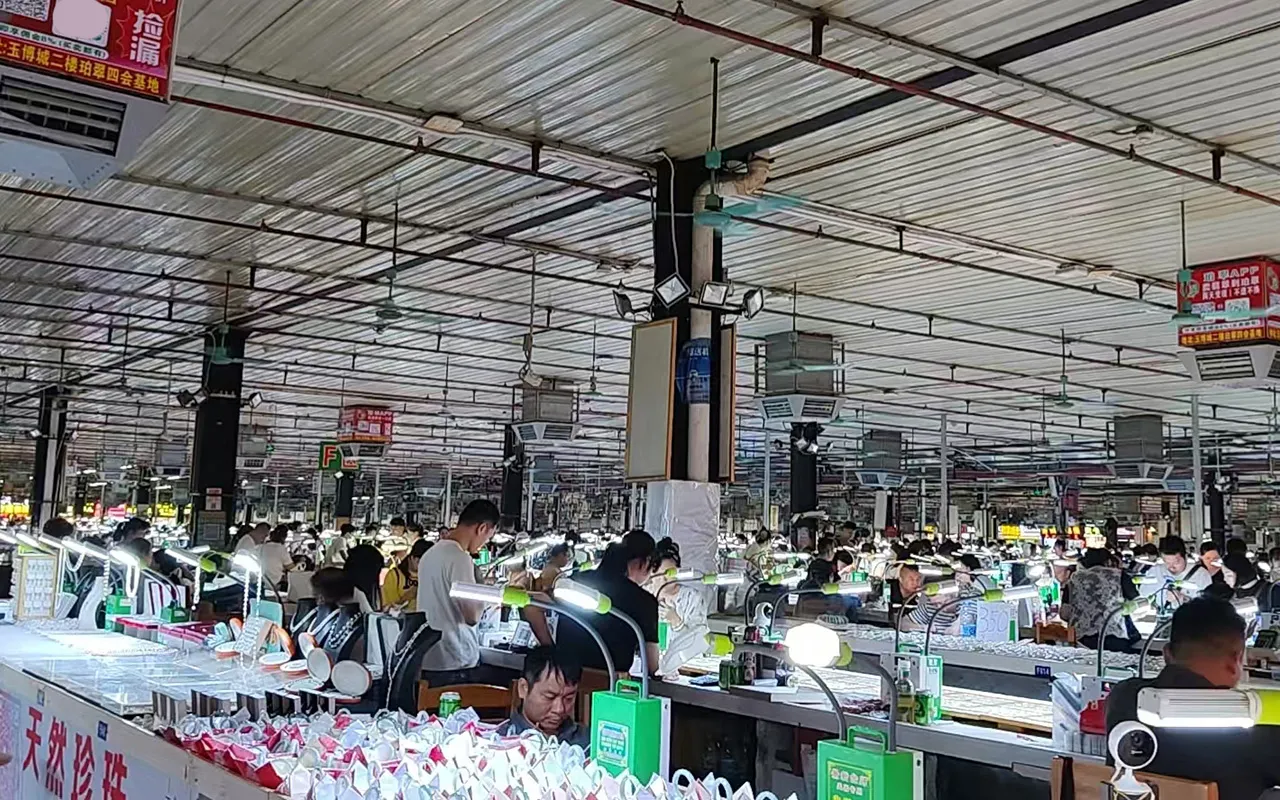
Inside one of the main trading halls — stall after stall of jadeite under warm display lights.
When you walk into Tian'guangxu, the first thing that hits you is the sheer volume. Rows and rows of stalls, most of them lit with small warm-white LEDs to show off the jadeite's translucency. The air smells like incense from a few of the larger shops. Buyers crouch over display cases with portable flashlights, examining pieces one by one.
The market has a few distinct areas:
- Finished jadeite goods — This is the main section and what most overseas buyers care about. Hundreds of stalls displaying finished bangles, pendants (平安扣 ping'an kou, wu shi pai, guanyin, buddha figures), beads, bracelets, necklaces, and ornamental carvings. You pick what you like, negotiate the price, done.
- Semi-finished pieces — Cut slabs and pre-forms that haven't been polished or set yet. Useful if you want custom work done.
- Custom carving workshops — Some stalls work with carvers who can create custom pieces from jadeite you select. You choose the stone, tell them the design, and come back in a few weeks.
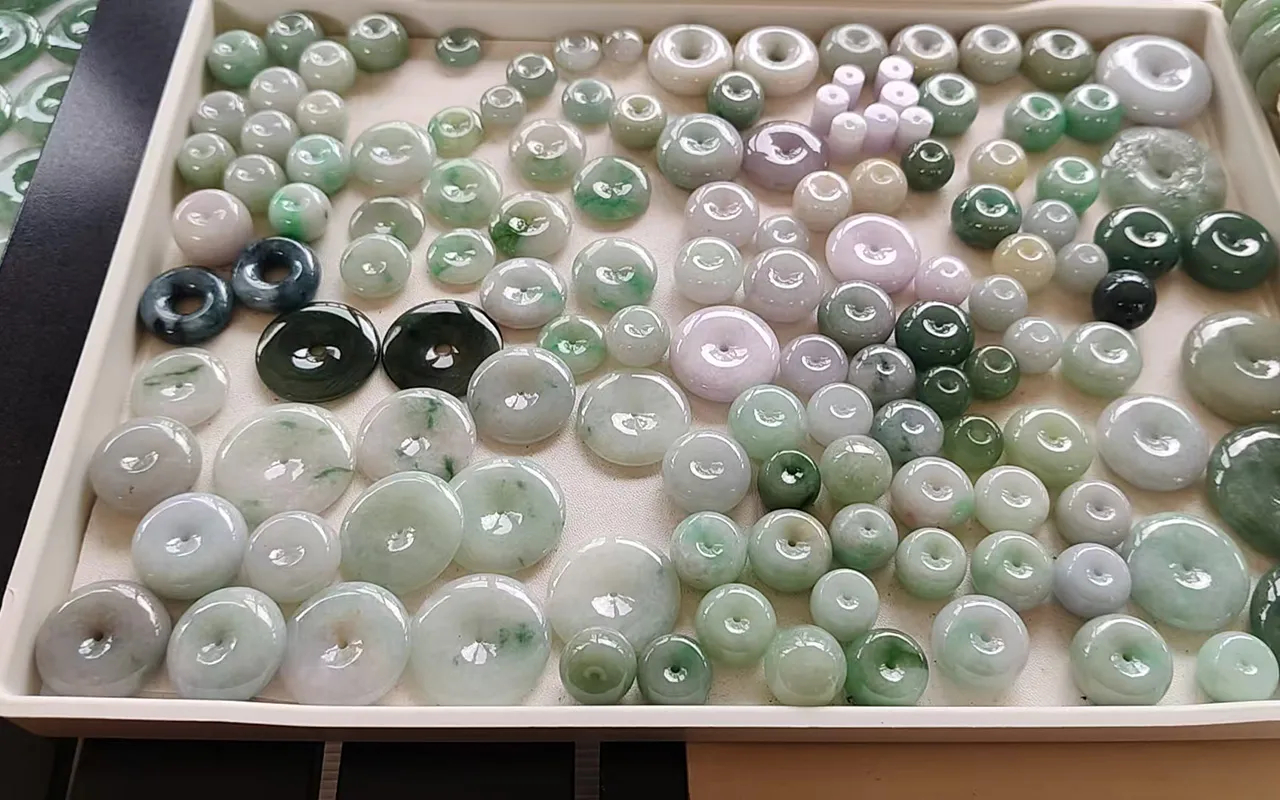
Ping'an kou (平安扣) — one of the most popular jadeite pendant styles. Literally translates to "peace button," a traditional Chinese symbol of safety and good fortune.
The energy is fast-paced but surprisingly quiet — most negotiations happen in low voices. Stall owners sit behind glass display cases, watching you pick up pieces and examining them under light. A handshake or a nod seals the deal. Cash and WeChat Pay are the standard — international buyers would need a local agent to handle payments.
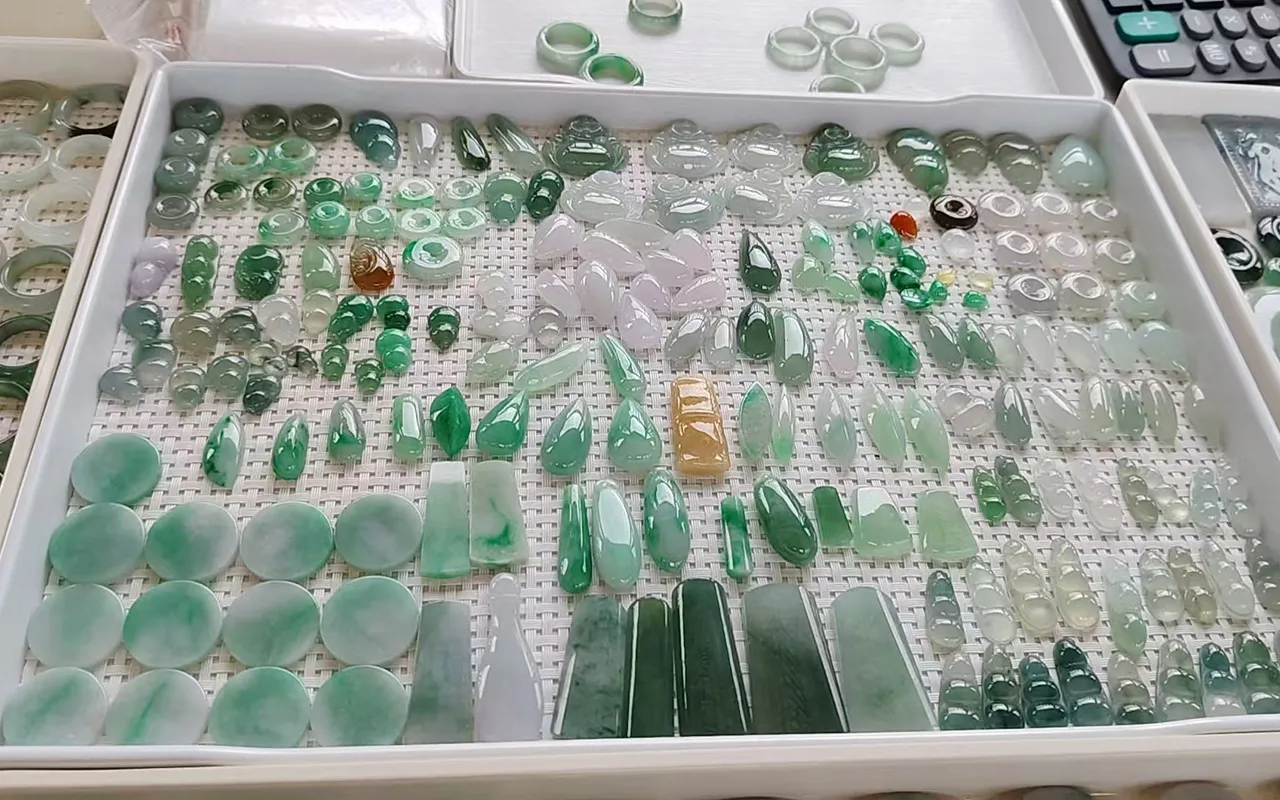
A typical stall display — jadeite bangles, wu shi pai (无事牌), pendants and hanging pieces, each in different colors and translucency grades.
A/B/C Grades: The One Thing You Must Understand Before Buying
This is the part that trips up almost every overseas buyer I've worked with. And frankly, it's where a lot of dishonest sellers make their money.
Jadeite is graded into three categories based on whether it's been treated:
| Grade | What It Means | Treatment | Should You Buy It? |
|---|---|---|---|
| Type A | 100% natural jadeite. No chemicals, no dyes. Only polished with traditional wax. | None | ✅ This is what you want |
| Type B | Bleached with acid to remove impurities, then injected with polymer resin to add clarity. | Acid + polymer | ⚠️ Degrades over time. Must be disclosed. |
| Type C | Same as B, plus artificial dye. The color fades with exposure to light and heat. | Acid + polymer + dye | ❌ Avoid. Period. |
The Scam That Catches Everyone
Type B and C jadeite are routinely sold as "natural" to buyers who don't know the difference. The resin in Type B makes the jadeite look more translucent than it really is — so it can appear to be high quality at first glance. Within months (sometimes weeks), the resin starts to break down: the stone becomes cloudy, cracks may appear, and the color shifts. Type C is even worse — the dye literally washes out.
When I source jadeite for clients, I only buy Type A unless a client explicitly asks otherwise, and I always disclose the grade. If you need an official certification, we can arrange that too.
How to Tell Good Jadeite from Expensive Garbage
Forget everything you've read about "imperial green" being the gold standard. Here's what actually matters when you're evaluating jadeite — in order of importance:
1. Transparency (通透度) — The #1 Factor
Hold any piece of jadeite up to a light source. The more light that passes through it, the more valuable it is. The top-tier varieties are called bing zhong (冰种, "icy type") and bo li zhong (玻璃种, "glassy type") — they're nearly transparent, like holding a piece of colored ice. If the stone is opaque or cloudy, it's lower quality regardless of how green it is.
2. Color — But Only Combined with Transparency
Green is the classic jadeite color, yes. But a pale green icy-type piece is worth more than a deep green opaque piece. Color + translucency together is what drives value. Beyond green, you'll also find lavender, white (often called "mutton fat"), yellow, red, and black jadeite — each with its own market and price range.
3. Texture — How It Feels
Good jadeite feels smooth, almost cool and silky to the touch. If you run your fingernail across the surface and feel graininess or roughness, that's a sign of lower quality or poorer polishing.
4. Internal Clarity — What's Inside
Look for cracks, white cloudy inclusions, or dark spots. In bangles especially, even a hairline crack can reduce the value by 50% or more, because bangles are cut from a single piece of stone and can't be repaired.
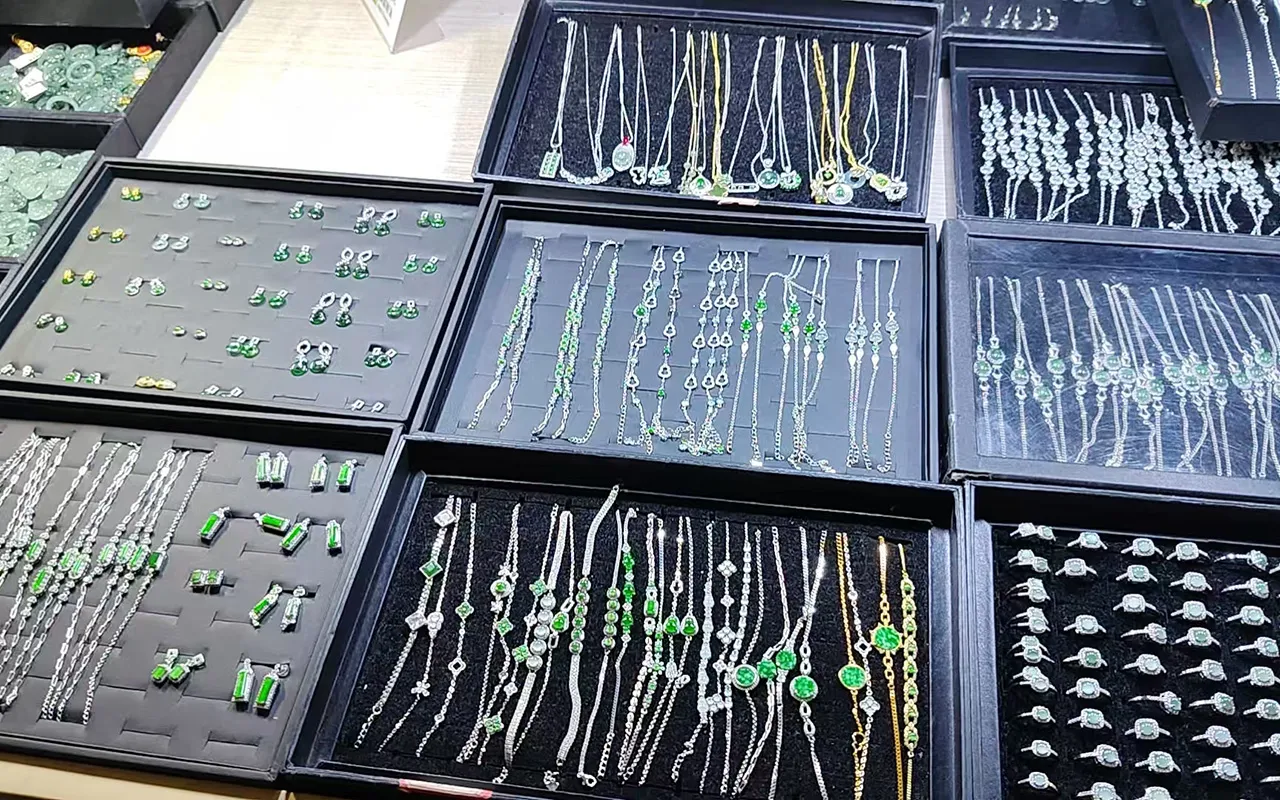
Jadeite bracelets and necklaces — each piece varies in color and translucency. The best way to judge quality is to see them in person under natural light.
How I Source for Overseas Buyers (Step by Step)
I've done this hundreds of times. Here's the exact process:
Examining jadeite pieces at a stall — I always bring a portable LED light to check translucency accurately.
- You tell me what you want — Send me a message on WhatsApp or email with the type of jadeite you're looking for (bangles, pendants, beads, carvings), your preferred quality level, and your budget. Even a simple message like "I want 20 icy-type green bangles under $50 each" is enough to get started.
- I go to the market — Usually the same day or next morning. I visit multiple stalls, compare options, and take photos in natural light (never with filters — what you see is what you get).
- I send you a shortlist — You'll receive photos with my honest assessment of each piece's quality, grade, and a fair price. I'll also tell you if I think something is overpriced, even if the stall owner doesn't like that.
- You pick what you want — Or I can do a live video call from the market so you can see the pieces yourself in real time.
- I negotiate and purchase — I get better prices than you'd walking in alone, because the stall owners know me and know I bring repeat business.
- Quality check — I inspect every piece one more time before packing. No cracks, no switching, no surprises.
- Custom packaging (optional) — Jewelry boxes, pouches, or branded packaging with your logo. Just ask.
- Ship to your door — Air freight, sea freight, or express courier — whatever fits your timeline and budget.
My Promise
I will never ship Type B or C jadeite as Type A. If a piece doesn't meet the quality I described in my photos, I won't ship it — simple as that. If you need an official certification for your market, I can arrange that as well.
Getting Your Jadeite Home Safely
Jadeite is tough (hardness 6.5–7 on the Mohs scale), but it can chip or crack if packed poorly. Here's how I handle shipping:
- Small orders (1–20 pieces) — Express courier (DHL/FedEx), door to door. Usually 5–10 days. Each piece is individually wrapped in bubble wrap, then placed in a padded jewelry box with foam inserts.
- Medium orders (20–200 pieces) — Air freight. 5–12 days to most international destinations. Professional packaging with insurance included.
- Large orders (200+ pieces) — Sea freight. 20–35 days. Lower cost per piece. I use reinforced wooden boxes with custom foam inserts so nothing moves in transit.
Every shipment includes a commercial invoice, packing list, and certificate of origin. If your country requires specific documentation for jadeite imports, let me know in advance and I'll make sure it's all sorted.
Questions I Get Asked the Most
No minimum. You can buy one bangle, one pendant, or a hundred — it's up to you. At Tian'guangxu, everything is sold by the piece. You pick exactly what you want.
Fair question. I inspect every piece personally before shipping. I only buy Type A unless you specifically request otherwise. If you want extra peace of mind, I can arrange an official laboratory certification before export. Full transparency — that's my business model.
Two options: I send detailed photos in natural light with my honest assessment, or we do a live video call from the market so you can see the pieces yourself and ask me to check anything in real time. Most of my clients do the video call — it's the next best thing to being here.
Yes. There are carving workshops in Sihui that can create custom pieces from jadeite you select. Send me your design or a reference image, and I'll source the right stone material and coordinate with the carver. Custom pieces typically take 20–45 days depending on complexity.
For ready-made pieces (bangles, pendants, beads already at the market): 1–2 weeks for sourcing and QC, plus 5–12 days shipping. Total roughly 2–4 weeks to most countries. Custom pieces add 20–45 days. I always give you a clear timeline before you pay anything.
All shipments include insurance. I pack everything professionally — individual bubble wrap, padded boxes, foam inserts. In over three years of sourcing, I've had zero damage claims on jadeite shipments. If something does happen, you're covered.
PayPal, Wise, or bank wire transfer for agent service fees. For the jadeite purchase itself, T/T (bank transfer) is standard. All terms are agreed in writing before any money changes hands.
Yes. Custom jewelry boxes, pouches, and swing tags with your logo. Simple kraft paper boxes to premium velvet-lined cases — whatever fits your brand. Lead time about 10–15 days for packaging production.
Want Me to Go to the Market for You?
Tell me what you're looking for. I'll be at Tian'guangxu tomorrow morning anyway — might as well check for your pieces while I'm there.